
The short answer: choose by experience, not by fame
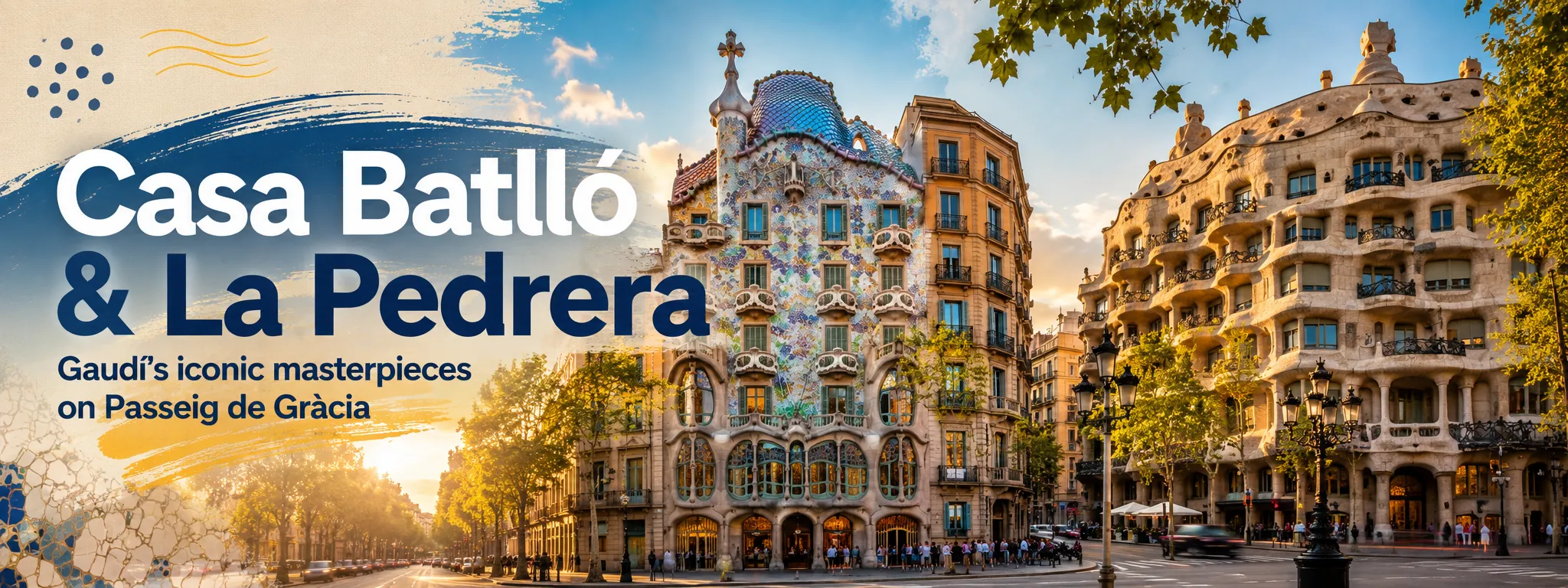
Casa Batlló and La Pedrera (Casa Milà) are less than ten minutes apart on Passeig de Gràcia, both are Gaudí landmarks, and both now sell several layers of visitor experience. That makes the obvious question — “which one is better?” — surprisingly unhelpful. Casa Batlló is the more theatrical, sensory house; La Pedrera is the stronger choice for understanding Gaudí's architecture as a complete residential system, with courtyards, an apartment, attic and rooftop all explaining different parts of the building.
If your time and budget allow, visiting both is not redundant. If you only want one paid Gaudí house, choose according to what you want to remember: colour, fantasy and immersive presentation at Casa Batlló; structure, space and the sculptural rooftop at La Pedrera.
What Casa Batlló actually feels like
Casa Batlló is a remodelled urban house with a façade that looks almost liquid: bone-like columns, mask-shaped balconies and a tiled roof often compared with a dragon's back. Inside, the design keeps changing as you move upward — curved doors, blue-tiled light wells, ventilation details and furniture-scale decisions make the building feel unusually intimate for a major attraction.
The current official visit is deliberately experiential. Casa Batlló includes an audio guide, digital and audiovisual elements, and multiple ticket products. Its general visit is advertised at about 1 hour 15 minutes. That is useful as a minimum, but architecture lovers should allow longer because the building rewards slow observation rather than simply following the media sequence.
One advantage is location: number 43 Passeig de Gràcia, right in the Manzana de la Discòrdia, where Casa Amatller and Casa Lleó Morera make the street itself part of the visit. You can build an excellent Modernisme walk around it without adding transport time.
What La Pedrera actually feels like
La Pedrera is larger, more austere and easier to read as a radical apartment building. Its undulating stone façade and wrought-iron balconies are famous, but the best part is seeing how the courtyards, circulation, attic and roof connect. The attic's catenary arches give you a clearer sense of Gaudí as an engineer, while the rooftop turns chimneys, ventilation towers and stair enclosures into a landscape of stone forms.
The official “Essential” visit includes the courtyards, apartment, attic and rooftop, with a video guide. La Pedrera also offers sunset, night and other premium products, so compare what is actually included before assuming two similarly priced tickets are equivalent. Its standard daytime experience generally feels more museum-like and architectural than Casa Batlló's immersive storytelling.
Casa Batlló vs La Pedrera: the meaningful differences
| If you care most about… | Choose | Why |
|---|---|---|
| Colour and visual drama | Casa Batlló | The interiors and façade are more immediately fantastical. |
| Architecture and building systems | La Pedrera | Courtyards, apartment, attic and roof explain the whole residential concept. |
| Rooftop experience | La Pedrera | The sculptural roofscape is one of Gaudí's defining spaces. |
| Immersive digital presentation | Casa Batlló | The visitor experience leans heavily into sound, screens and staged interpretation. |
| A quieter intellectual visit | La Pedrera | It is easier to focus on structure and urban design rather than spectacle. |
| One “wow” house for a first trip | Casa Batlló | It delivers the most concentrated fairytale-Gaudí impression. |
Tickets and 2026 price reality
Both attractions use dynamic products and online booking, so a travel article should not pretend there is one permanent ticket price. On 30 August 2026, the official Casa Batlló site listed its general visit from €29 and La Pedrera listed its Essential visit from €29. More expensive products add early entry, sunset or night experiences, private areas, food or performances.
The useful advice is to compare the exact product inclusions and the official checkout price for your date. Casa Batlló advertises savings for advance online purchase, while La Pedrera splits its schedule into daytime, sunset and night products. If you are visiting in a busy period, booking ahead is sensible; these are globally famous attractions with timed capacities.
How much time to allow
Casa Batlló's official general-visit duration is around 1 hour 15 minutes. La Pedrera can also be seen briskly, but 90 minutes is a more comfortable allowance if you want the courtyards, apartment, attic and rooftop without rushing. Add time for queues, security, shop exits and simply getting oriented.
Do not book them back-to-back with only the walking time between. A two-house morning can work well, but leave a buffer and a coffee break. If you add Sagrada Família on the same day, you are building a Gaudí marathon; some travellers love that, others stop noticing details after the second audio guide.
Crowds and the best order
Early entry is the most reliable strategy if photos and a calmer interior matter. Casa Batlló's narrower interior sequence can feel more compressed when busy, while La Pedrera's larger spaces distribute people somewhat better until the rooftop. Late afternoon can be attractive for light but is not automatically quiet.
If you visit both, start with the one you care about most. Fatigue changes how much attention you give to the second building. Architecture enthusiasts might begin at La Pedrera and then enjoy Casa Batlló as a sensory contrast; first-time visitors may prefer the reverse.
Accessibility differences matter
Both sites publish detailed accessibility information, and both use lifts, but historic architecture imposes different limits. Casa Batlló says wheelchair users can visit all areas of the house and provides priority lift use, subtitled tablets and other accessibility support. Check the official page for the exact setup relevant to your needs.
La Pedrera is partially accessible for wheelchair users. Its official guidance says the courtyards, Tenants' Apartment and Gaudí Space in the attic can be visited without mobility obstacles, while the rooftop is uneven; a lift reaches a viewing platform, but wheelchair access across the rooftop itself is not possible. This difference can decide the comparison for travellers whose main interest is the roof.
Which is better with children?
Casa Batlló's imaginative shapes and digital interpretation often make it easier for children to engage without a long architecture explanation. The official site also currently offers free general admission for children aged 0–12, although specific products differ. La Pedrera has more space and a spectacular rooftop, but the educational value may land better with older children who can connect the attic models and apartment layout to Gaudí's ideas.
With a stroller, check the current visitor rules before arrival; historic stairs and controlled visitor flow can affect where equipment is stored or how lifts are used.
What you can appreciate without buying a ticket
You can learn a surprising amount from Passeig de Gràcia for free. Casa Batlló's façade is fully visible from the pavement, and Casa Amatller beside it adds immediate context. La Pedrera's stone façade, ironwork and corner massing are also best understood from across the street. An architecture walk from Plaça de Catalunya to Diagonal can therefore be worthwhile even if you enter neither building.
Use our Eixample guide to turn the houses into part of a broader district walk, and the Gaudí and Modernisme guide for the movement's wider context.
If you visit both: a simple half-day plan
Book the first house early, allow around 90 minutes, then walk Passeig de Gràcia slowly rather than treating the gap as dead time. Look at Casa Amatller, street lamps, paving and neighbouring façades. Stop for a break before the second timed entry. Afterward, continue into Eixample for lunch rather than immediately adding another paid monument.
This rhythm gives the houses contrast. Without the street in between, two expensive interiors can blur together; with the boulevard as connective tissue, you see why these buildings mattered to Barcelona's turn-of-the-century bourgeois city.
Common comparison mistakes
- Choosing only by ticket price: products and inclusions differ, so compare like with like.
- Assuming Casa Batlló is “better” because it is more colourful: La Pedrera reveals different architectural strengths.
- Booking them ten minutes apart: timed entry plus real visit duration needs a buffer.
- Ignoring accessibility: rooftop access is especially important to verify at La Pedrera.
- Trying to do every Gaudí site in one day: quality of attention matters more than attraction count.
If the cost of two Gaudí houses feels excessive, spend your money on one interior and use the other as part of a self-guided Passeig de Gràcia walk. Read about the building before entering, arrive rested, use the included interpretation rather than racing through for photos, and give the rooftop or light well time to make sense spatially. The difference between a memorable €29–plus visit and an overpriced one is often attention rather than the ticket tier. Premium products can be worthwhile for special access or timing, but do not assume the most expensive option is automatically the best introduction to Gaudí.
How to get better value from one expensive ticket
Yes. The two houses are only a short walk apart on Passeig de Gràcia, so pairing them is geographically easy. The harder question is attention fatigue: both are architecture-heavy, audio-guided experiences with rooftops and interiors. If you care deeply about Gaudí, book one earlier and one later with a meal or neighbourhood walk between them. If you are only mildly interested, choose one and use the saved time for Sagrada Família, Sant Pau or the streets of Eixample.
Can you visit both on the same day?
Official sources checked
- Casa Batlló — general visit, for current experience and visit duration.
- Casa Batlló — official tickets, for current 2026 products and prices.
- Casa Batlló — practical information, for accessibility and visitor services.
- La Pedrera — official tickets, for current visit products and inclusions.
- La Pedrera — practical information, for 2026 opening schedules and closures.
- La Pedrera — accessibility, for wheelchair and rooftop access detail.