Eixample in one minute
Eixample is the large 19th-century district wrapped around Barcelona's old city. Its name means “extension”, but for a visitor it is better understood as the part of central Barcelona where monumental architecture and ordinary city life overlap. The streets are broader than in the Gothic Quarter, the blocks follow Ildefons Cerdà's famous grid, and the clipped corners create the chamfered intersections that make the district instantly recognisable from above.
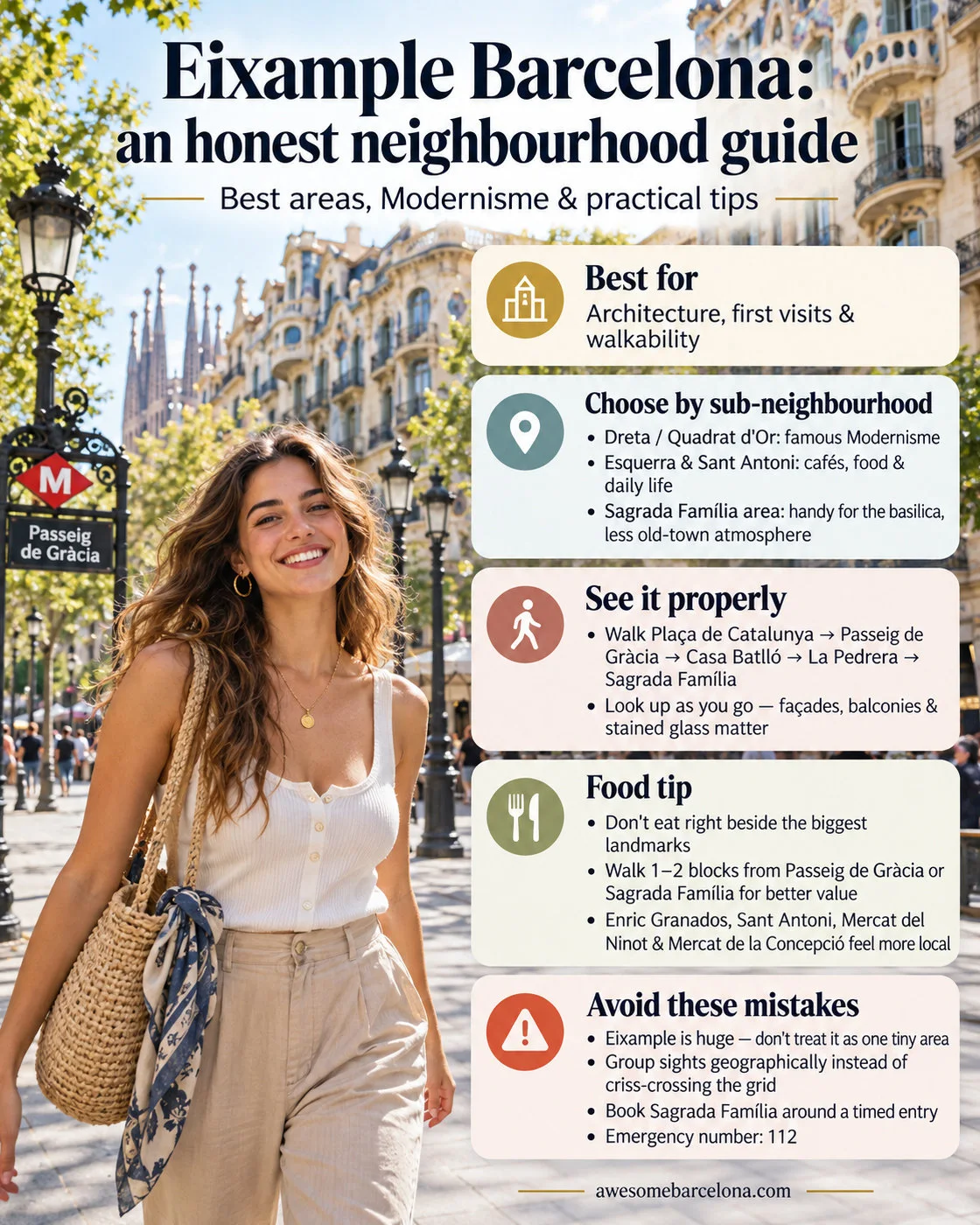
The district is huge, so saying you are “staying in Eixample” is not very precise. The experience around Passeig de Gràcia is polished and architecture-heavy; Sant Antoni and the Esquerra side feel more residential and food-focused; the Sagrada Família area is convenient for the basilica but farther from the medieval centre; Fort Pienc is quieter and useful for transport. Think in sub-neighbourhoods, not one giant zone.
Why the grid looks like this
Barcelona expanded beyond its old walls in the 19th century, and engineer Ildefons Cerdà designed a new urban framework intended to distribute light, air, movement and public services more evenly. The result was a regular grid of blocks with chamfered corners. The original social ideals were changed as the district was built out, but the basic geometry remains the defining structure of modern central Barcelona.
That layout matters to travellers. Navigation is straightforward, long sightlines make orientation easier, and crossings often feel more open than in Ciutat Vella. It also means distances can be deceptive: five blocks on a map can still be a substantial walk. Plan by clusters rather than zig-zagging repeatedly across the district.
Which part of Eixample should you choose?
Dreta de l'Eixample and the Quadrat d'Or
The right side around Passeig de Gràcia contains the densest concentration of famous Modernisme façades. Tourism of Barcelona describes the central Quadrat d'Or, roughly between Carrer Aribau and Passeig de Sant Joan around Passeig de Gràcia, as an open-air museum of late-19th- and early-20th-century architecture. This is the obvious choice if Casa Batlló, La Pedrera and elegant boulevards are central to your trip.
Antiga Esquerra and Nova Esquerra
The left side generally trades landmark density for neighbourhood convenience. It is good for travellers who want cafés, restaurants and daily life close at hand without being on the busiest sightseeing axis. The area around Enric Granados is particularly pleasant for walking, while the broader Esquerra stretches west toward Plaça d'Espanya.
Sant Antoni
Sant Antoni sits on the old-town edge of the district and works well for people who want food, nightlife and quick walks into Raval or Poble-sec. It is less monumental than Passeig de Gràcia but often feels more useful day to day.
Sagrada Família
Staying near the basilica makes an early or late visit extremely easy and gives you good metro links, but you are not in the middle of Barcelona's evening old-town atmosphere. Choose it for the monument and a residential feel, not because it is the geometric centre of everything.
How to see the Modernisme properly
Do not treat Eixample's architecture as three isolated ticketed attractions. The official Barcelona Modernisme Route exists precisely because the movement is embedded across the streetscape: residences, shops, street furniture and lesser-known façades sit between the famous buildings by Gaudí, Lluís Domènech i Montaner and Josep Puig i Cadafalch.
A strong first walk starts at Plaça de Catalunya, follows Passeig de Gràcia past the Block of Discord and Casa Batlló, continues to La Pedrera, then cuts across the grid toward the Sagrada Família. Look upward as you walk. Balconies, entrance halls, stained glass, sgraffito and carved stone are often more rewarding than rushing directly from ticket door to ticket door.
Rambla de Catalunya, parallel to Passeig de Gràcia, is a useful slower alternative for part of the route. Tourism of Barcelona highlights its tree-shaded central promenade, terraces, shops and Modernisme details. It is usually a better place to pause than the busiest sections of Passeig de Gràcia itself.
Major sights: what deserves your time
Sagrada Família
This is the one attraction for which improvisation is a poor strategy. Use the basilica's official ticketing channel and choose a timed visit that fits your day. Our dedicated guide covers the visit in depth; on an Eixample day, the practical point is to build the rest of your route around your confirmed entry time rather than the other way around.
Casa Batlló and La Pedrera
They are close enough to combine, but most visitors do not need full paid interiors at every Modernisme building. If architecture is a major interest, choose two interiors deliberately. If not, enjoy the façades and spend your paid-ticket budget on the building whose interior or rooftop appeals most.
Sant Pau and the wider Modernisme route
If you have more time, extend beyond the standard Passeig de Gràcia loop. The Modernisme story does not end with Gaudí, and the broader route helps explain why the style became part of Barcelona's civic identity rather than simply a collection of photogenic houses.
A practical half-day Eixample walk
- Start at Plaça de Catalunya. It marks the practical seam between the old city and Eixample.
- Walk north on Passeig de Gràcia. Slow down around the Block of Discord and Casa Batlló rather than viewing it only from across traffic.
- Continue to La Pedrera. Then take a break on Rambla de Catalunya or a side street instead of staying on the retail spine.
- Cut east through the grid. This is where you see ordinary Eixample: pharmacies, bakeries, schools, apartment entrances and quieter façades.
- Finish at Sagrada Família. If you have a ticket, time your cross-town walk to arrive comfortably before the booked slot.
Trying to add the Gothic Quarter, Park Güell and Montjuïc to this same half-day turns a neighbourhood walk into a transport exercise. Eixample rewards looking rather than collecting.
Eating and drinking without falling into the obvious traps
Eixample has enormous restaurant choice, but the busiest landmark streets are not automatically the best value. Walk a block or two away from Passeig de Gràcia and the Sagrada Família perimeter before deciding where to eat. Around Enric Granados, Sant Antoni, Mercat del Ninot and Mercat de la Concepció you have more neighbourhood-oriented options and a better sense of normal Barcelona food rhythms.
Markets are useful for orientation as much as meals. They show how the district works beyond tourism and are good places to understand produce, charcuterie, seafood and prepared-food culture before you tackle a long restaurant list. Avoid pretending there is one “best tapas bar”; quality and atmosphere vary, and a current busy local bar can be a better choice than an old guidebook name.
Getting around Eixample
The district is crossed by several metro lines and a dense bus network. Passeig de Gràcia is a major interchange, and TMB completed accessibility improvements there in late 2025 that improved step-free transfers between metro lines and Rodalies. TMB also provides live station and lift-status information, which is more useful than a static travel article if accessibility is important on the day you travel.
For most central sightseeing, walking is still the best default. The grid makes it easy to change plans, and a 20-minute walk often reveals more than a short metro hop. Use transit to bridge the longer jumps — especially to Park Güell, Montjuïc, the beach or an airport connection — rather than automatically taking it between every Eixample stop.
Accessibility and mobility considerations
Eixample's broad pavements and relatively regular street plan are generally easier to navigate than many narrow old-town lanes, but curb works, restaurant terraces and heavy pedestrian traffic can still complicate routes. Barcelona's buses are adapted for reduced mobility and most metro stations have lifts, according to TMB, but not every possible station route is identical. Check the specific station and lift status before relying on a transfer.
If you need a lower-effort sightseeing day, base it around Passeig de Gràcia and Rambla de Catalunya, use a bus or taxi for the longer jump to Sagrada Família, and avoid building an itinerary that depends on repeated cross-district walks.
Safety and street sense
Eixample usually feels calmer than the busiest old-town corridors, but central Barcelona still demands normal big-city awareness. Catalonia's Mossos d'Esquadra advises visitors to keep possessions controlled in streets and transport and to use straightforward self-protection measures. The highest-risk moments are often distraction points — crowded platforms, café terraces, queues and busy junctions — rather than a particular Eixample street.
Do not hang a phone or bag loosely over the back of a chair, and keep valuables organised before entering the metro rather than opening a wallet at the barrier. The emergency number is 112.
Is Eixample a good place to stay?
For many first-time visitors, yes. It is central without forcing you into the densest old-town streets, transport is strong, and the district gives you useful choices at different price levels. The trade-off is atmosphere: if your dream is to step out into medieval lanes at midnight, choose the Gothic Quarter or Born instead; if your priority is sand and sea, look toward Barceloneta or Poblenou.
For a broader comparison, use our best areas to stay in Barcelona guide. Within Eixample itself, choose the immediate surroundings — not just the district name — and check walking distances to your likely evening destinations.
When Eixample is at its best
Early morning is excellent for architecture because the pavements are quieter and the façades are easier to study. Late afternoon works well for a Passeig de Gràcia-to-Sagrada Família walk, followed by dinner on a side street. Midday in summer can be tiring on exposed cross-town walks, so use shaded Rambla de Catalunya, indoor attractions and a slower lunch to break the day.
On Sundays and public holidays, the district can feel noticeably quieter away from attractions. That can be pleasant, but do not assume every small shop or market stall will keep weekday hours.
Common Eixample planning mistakes
- Treating the district as tiny. It stretches far beyond Passeig de Gràcia; check the actual address of accommodation.
- Booking every famous interior. Architecture fatigue is real. Mix paid interiors with street-level viewing.
- Eating only beside landmarks. One or two blocks can make a large difference to atmosphere and value.
- Crossing the same grid repeatedly. Group sights geographically and keep one direction of travel.
- Ignoring accessibility details. Use TMB's current station/lift information if step-free routing matters.
Official sources and further planning
For current background and visitor planning, check Tourism of Barcelona's Eixample overview, its Quadrat d'Or guide, the municipal Barcelona Modernisme Route, and TMB accessibility information. For safety, use the Mossos visitor-safety guidance.