
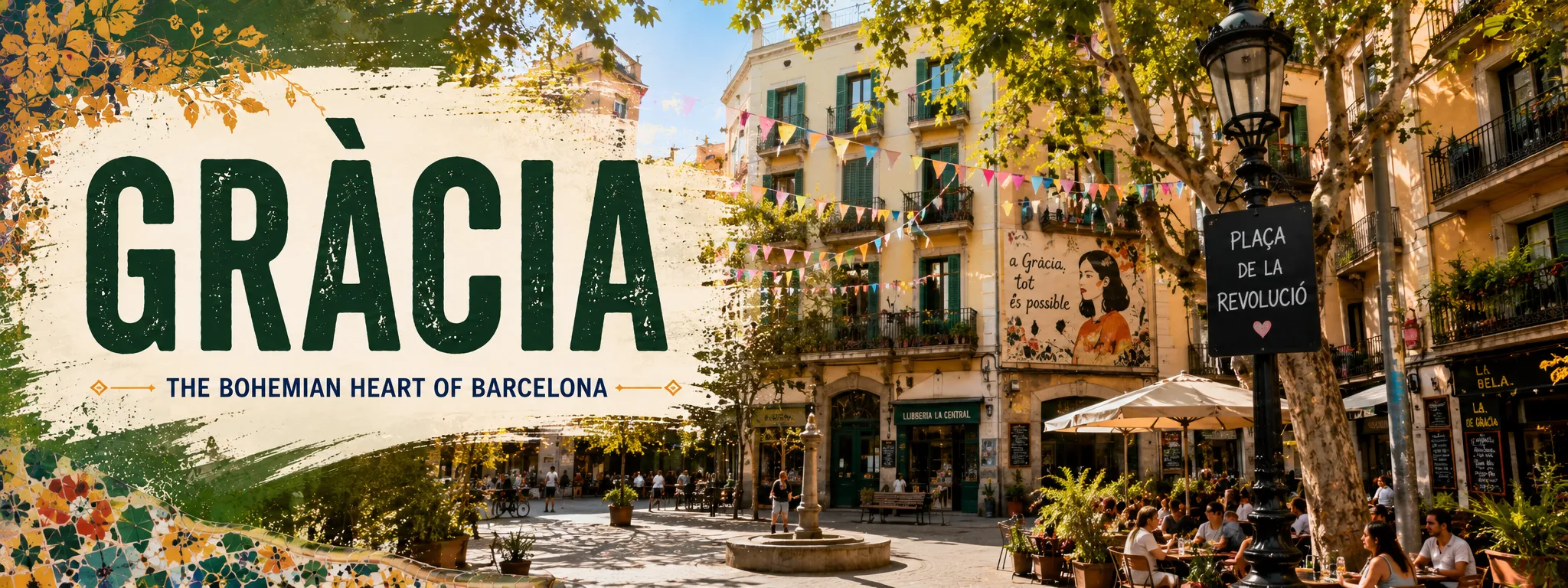
Why Gràcia feels different
Gràcia is one of the best Barcelona bases for travellers who want city life without feeling permanently inside the sightseeing core. It was an independent town until Barcelona absorbed it in 1897, and the old street pattern still shows: narrow lanes open suddenly into small squares, daily life clusters around markets and cafés, and the scale is noticeably more intimate than Eixample immediately downhill.
Tourism of Barcelona describes the former village as a neighbourhood with a strong civic and cultural identity. That history is not just decorative background. It explains why Gràcia works so well on foot and why its plazas remain social spaces rather than merely monuments to photograph.
Where Gràcia starts and ends for visitors
The most visitor-friendly core is Vila de Gràcia, roughly north of Diagonal and west of the Park Güell slopes. Passeig de Gràcia itself belongs to Eixample for most of its famous Modernista stretch, despite leading directly toward the old village. Park Güell sits uphill in the wider Gràcia district, so a day that combines Vila de Gràcia with the park involves more climbing than the map first suggests.
Use the squares as your map
Instead of trying to tick off a long attraction list, move between the neighbourhood's squares. Plaça del Sol is lively and youthful; Plaça de la Vila de Gràcia is anchored by its clock tower; Plaça de la Virreina feels softer and more residential; and Plaça del Diamant connects the neighbourhood with Mercè Rodoreda's The Time of the Doves and the memory of Civil War air-raid shelters beneath the streets.
Tourism of Barcelona notes that Gràcia has more than fifteen squares. They are the neighbourhood's real public rooms, and they are also why evenings can be noisy around the most popular ones. If sleep matters, a room one or two streets away can be a much better choice than a balcony directly over a plaza.
What to see and do
Casa Vicens, Gaudí's early house, is the major architectural sight inside Vila de Gràcia. Park Güell is the headline attraction farther uphill, but it deserves its own booked visit rather than being treated as a casual neighbourhood park. Between those anchors, Gràcia is better for wandering than attraction collecting: Carrer de Verdi, local cinemas, small galleries, independent shops and the market streets make the area rewarding without a fixed route.
Eating and evenings
Gràcia has an unusually broad mix of everyday Catalan cooking, vermouth bars, bakeries and international restaurants. The useful strategy is to step away from the busiest square frontage and look one or two blocks deeper. Dinner culture runs late by Australian or northern-European standards, but you do not need to force yourself into a 10pm meal: many places serve earlier, particularly those used to visitors.
In August, Festa Major de Gràcia can transform decorated streets into one of Barcelona's biggest neighbourhood celebrations. It is a great reason to visit and a poor time to expect silence, so check event dates if you are booking accommodation nearby.
Getting there and around
Fontana and Lesseps on metro line L3 are useful for the upper and central parts of Vila de Gràcia, while Diagonal links L3 and L5 near the southern edge. Much of the neighbourhood itself is best walked. The terrain rises toward Park Güell and Collserola, so travellers with limited mobility should check gradients and use bus or taxi connections rather than assuming every route is flat.
Should you stay in Gràcia?
Choose Gràcia if you value evenings in local streets, independent restaurants and a neighbourhood rhythm over instant access to the old city's biggest sights. It is especially good for repeat visitors, couples and travellers staying long enough to enjoy ordinary mornings as much as landmark days.
Choose Eixample instead if you want the easiest transport geometry and larger hotel choice; the Gothic Quarter if historic atmosphere is the priority; or Barceloneta/Poblenou if beach access matters more. Gràcia is not “undiscovered” — it is popular and busy — but it still rewards travellers who want Barcelona to feel like a lived-in city.
A practical half-day route
Start near Diagonal, walk north through Vila de Gràcia, pause around Plaça de la Vila and Plaça del Sol, continue via Carrer de Verdi and Plaça de la Virreina, then finish around Casa Vicens or continue uphill toward Park Güell if you have a timed reservation. Reverse the route if downhill walking is easier for you.