
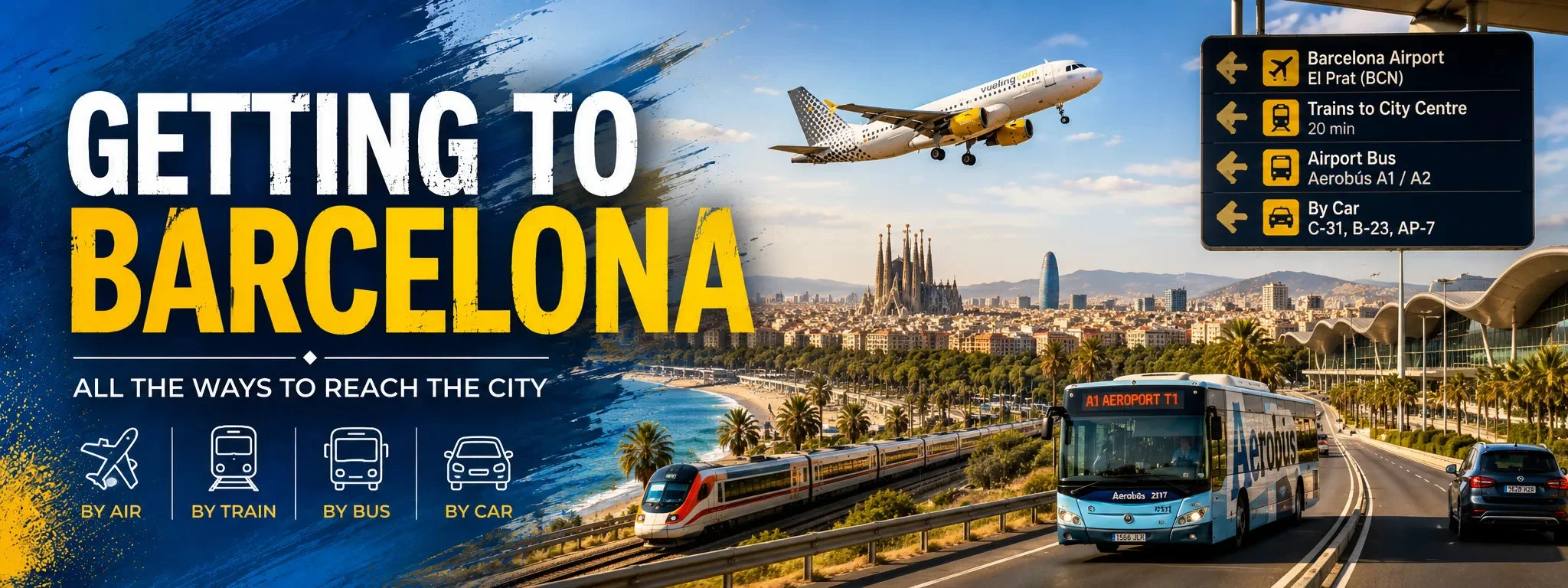
Choose your arrival route by where you are staying
Barcelona is easy to reach, but there is no single “best” transfer for every arrival. The useful question is where you need to end up, how much luggage you have, and whether you are arriving at Terminal 1, Terminal 2, Barcelona Sants or a cruise berth. For many first-time visitors, Aerobús is the simplest airport-to-centre option; the R2 Nord train is especially useful from Terminal 2 toward Sants and Passeig de Gràcia; Metro L9 Sud is strongest when your destination connects naturally with its western transfer stations; and a taxi earns its premium when you have heavy bags, children, reduced mobility or a late arrival.
Do not choose only by headline journey time. A route that looks five minutes faster can become slower after a long station transfer, a terminal shuttle, stairs with luggage or a second connection. Use this guide as a decision map, then check the live operator information on your travel day.
Barcelona–El Prat Airport (BCN): know your terminal first
Barcelona–El Prat has two main passenger terminals, T1 and T2. Your terminal matters because Aerobús and the airport Metro serve both, while the Rodalies rail station is on the T2 side. If you land at T1 and want the train, Aena operates a free 24-hour inter-terminal shuttle; allow extra time for the bus and the walk to the rail station rather than treating T1 as if it had its own Rodalies platform.
The same rule applies when departing: check the terminal on your airline booking before leaving the city. Barcelona airport is large enough that arriving at the wrong terminal can turn a comfortable buffer into a rushed transfer.
Aerobús: the easiest default for many city-centre stays
Aerobús runs separate A1 and A2 services for T1 and T2 and operates around the clock. It links the airport with central stops including Plaça Espanya, Sepúlveda and Plaça Catalunya. For visitors staying around the Gothic Quarter, Eixample, Plaça Catalunya or a hotel with an easy onward Metro/taxi connection, it is often the least complicated choice because there is no terminal-to-rail-station walk and luggage is expected.
Allow roughly the advertised transfer time plus traffic and the walk from the final stop. At busy road times, rail can be more predictable; late at night, Aerobús can be especially attractive because the service continues when some other connections become less convenient. Buy through the official Aerobús channels or at authorised machines/staff rather than assuming a third-party ticket is better value.
R2 Nord train: strong for Sants and Passeig de Gràcia
The airport rail station is beside T2 and the R2 Nord service connects into the Barcelona rail network, including major central interchange points. It can be an excellent arrival route if you are staying near Barcelona Sants, Passeig de Gràcia or somewhere with an easy onward connection. From T1, first use Aena's free terminal shuttle to T2 and budget for that extra step.
Rail is attractive when road traffic is heavy and when your accommodation sits near a useful station, but it is less compelling if you must make multiple awkward transfers with suitcases. Check Rodalies service information on the day because engineering works and disruptions can change the practical choice.
Metro L9 Sud: useful, but not usually a direct ride downtown
Metro L9 Sud serves both airport terminals and connects with the wider Metro network at stations including Torrassa, Collblanc and Zona Universitària. TMB gives the airport-to-city-network journey at about half an hour before your onward transfer. It can work very well for hotels near the western side of the city, Fira Gran Via, or routes that connect naturally with L1, L3, L5 or L10.
For a typical Plaça Catalunya, Gothic Quarter or central Eixample destination, however, the airport Metro usually requires a change and may involve more walking than Aerobús or R2 Nord. That does not make L9 Sud “bad”; it simply means you should compare the door-to-door route rather than the Metro segment alone.
Taxi and app-based rides: pay for convenience, not a mythical fixed city fare
Official Barcelona taxis are black and yellow, with authorised ranks outside the airport arrivals areas. They are a sensible option for families, groups who can share the cost, travellers with substantial luggage, people arriving after a long flight, or accommodation that is inconvenient by public transport.
There is not a single fixed airport-to-anywhere-in-Barcelona city fare. Airport taxi pricing follows the regulated metropolitan fare structure and applicable supplements/minimums, so use the official taxi information rather than an old travel-blog figure. App-based ride services also use designated airport pickup areas; follow the current Aena instructions in the app and terminal rather than waiting at a random curb.
Late-night arrivals: simplify the final kilometre
After midnight, the best route depends less on theoretical price and more on how cleanly you can reach your accommodation. Aerobús runs 24 hours, taxis remain straightforward, and night buses may be useful for travellers comfortable with the network. If you are landing tired with children or several bags, saving a small amount can be poor value if it creates two transfers and a long final walk.
Before flying, save the hotel address, reception instructions and a map offline. If your accommodation has restricted reception hours, solve that before choosing the cheapest transfer.
Reduced mobility and accessible airport transfers
Aena provides its Barrier Free assistance service for passengers with reduced mobility. For the most reliable support, request assistance in advance through the airline or Aena; Aena recommends doing so at least 48 hours before travel. Airport Metro stations and many central transport nodes have lifts, but an “accessible” network route can still involve longer platform changes than a taxi.
If step-free travel is critical, check the live lift status and the exact station path rather than assuming every transfer is equal. A direct taxi may be the simplest solution for some travellers, while others will prefer L9 Sud or an accessible rail/Metro combination.
Arriving by long-distance train at Barcelona Sants
Barcelona Sants is the city's principal long-distance rail station and the normal arrival point for high-speed services from Madrid and many other Spanish cities. Once at Sants, Metro, Rodalies, buses and taxis distribute passengers across Barcelona. If your hotel is in Eixample or near another central rail/Metro station, public transport is usually straightforward; for the old city with luggage, a taxi can remove a surprisingly inconvenient final walk over busy pavements.
Book long-distance tickets through the relevant rail operator and check the train number and station shown on your ticket. Do not hard-code a journey time into your plans: services, stopping patterns and works vary by date.
Arriving from France and the rest of Europe
Barcelona is connected to international rail and coach networks as well as a dense European flight network. Rail is especially appealing when it replaces airport security and distant transfers with a city-centre arrival, but the best choice depends on your origin and through-ticket options. For cross-border journeys, leave margin for a missed connection if your tickets are separate contracts.
If a low-cost flight is advertised as “Barcelona,” verify the airport code. BCN is Barcelona–El Prat. Girona and Reus are separate airports outside Barcelona and require a different ground-transfer plan.
Cruise arrivals: the berth matters more than the word “Barcelona”
Barcelona's cruise port has terminals in different zones. The World Trade Center terminals are close to the lower end of La Rambla and public transport; the large terminals on the Adossat wharf are farther out. Port de Barcelona lists the T-3 Portbus as the shuttle connection between the Adossat cruise terminals and the city-side port area.
Do not plan to walk from an Adossat terminal into the centre with cruise luggage just because the port looks close on a map. The port environment is built for vehicles, distances are deceptive, and summer heat makes the walk worse. For two or more people with luggage, a taxi can be the sensible door-to-door option.
Which airport route fits your neighbourhood?
- Plaça Catalunya / central Eixample: Aerobús is the simple default; R2 Nord plus an onward connection can also work well.
- Sants / Les Corts: R2 Nord or L9 Sud connections may be more logical than travelling all the way to Plaça Catalunya.
- Gothic Quarter / El Born: Aerobús plus Metro/taxi or R2 Nord via Passeig de Gràcia can reduce luggage dragging through narrow streets.
- Fira / L'Hospitalet: L9 Sud can be unusually convenient because the airport line serves this side of the metropolitan area directly.
- Accommodation far from a station: compare the final walk honestly; a taxi may win even when public transport is cheaper.
See our Getting Around Barcelona guide for city transport once you have checked in, and Best Areas to Stay if you are still choosing a base.
Luggage, children and group travel
Barcelona's public transport is generally practical with ordinary luggage, but lifts, platforms and busy carriages change the experience. A family of four with cases should compare the total taxi cost against four separate transfer tickets and the physical effort of changes. Conversely, a solo traveller with one cabin bag staying beside Sants may find the train hard to beat.
Keep passports, phones and wallets on your body rather than in an exposed outer suitcase pocket, particularly when loading and unloading in crowded transport areas. Barcelona's usual pickpocket precautions apply at major stations and airport-transfer stops.
Going back to the airport: build a real buffer
For departure day, work backwards from the airline's recommended airport arrival time, then add your city-to-airport journey and a disruption margin. Confirm T1 or T2, especially if you are using R2 Nord and need the terminal shuttle. Early-morning traffic, rail disruption, a missed Metro connection or a slow hotel checkout can consume a thin buffer quickly.
If your flight is high-stakes — a long-haul departure, separate onward ticket or important event — choose reliability over saving the last few euros.
Common arrival mistakes to avoid
- Assuming every airport transport option serves T1 and T2 in the same way.
- Buying T-Casual for the airport Metro gates; TMB says it is not valid there.
- Believing taxis have one fixed fare from the airport to every Barcelona address.
- Choosing Metro purely by map distance without counting transfers and luggage.
- Walking from an Adossat cruise terminal with heavy luggage.
- Failing to check whether a “Barcelona” flight actually lands at BCN, Girona or Reus.
- Leaving no margin for road, rail or lift disruption on departure day.
Official sources to check before travel
For live details, use Aena Barcelona–El Prat for terminals, airport transport and assistance; TMB's airport Metro guidance for L9 Sud and ticket validity; Aerobús for current stops and service; and Port de Barcelona for cruise-terminal transport. Check your rail operator separately for the exact train you intend to use.