
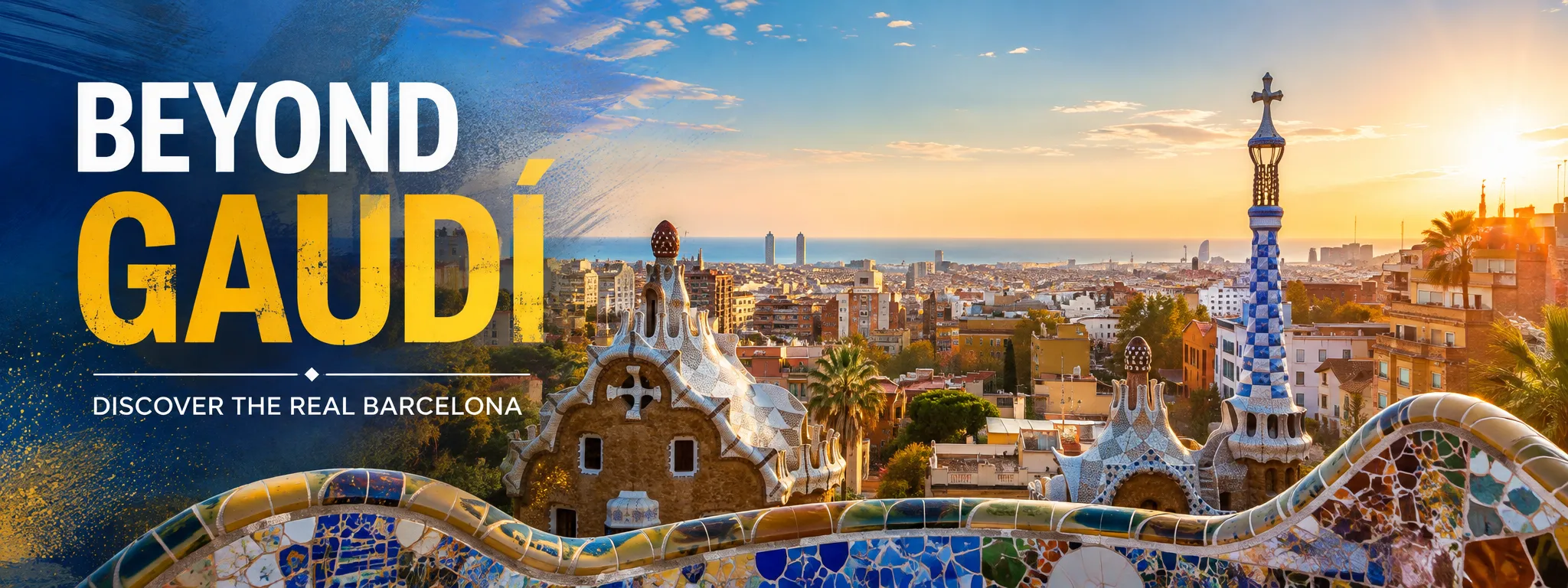
Modernisme was bigger than one famous name
Gaudí is the easiest doorway into Barcelona's Modernisme, but treating him as the whole movement flattens one of the city's most interesting periods. The late-19th- and early-20th-century Eixample became an architectural laboratory where prosperous families commissioned houses that competed through stone carving, ceramics, stained glass, ironwork and theatrical façades. Tourism of Barcelona's own guide to the Quadrat d'Or highlights Gaudí alongside Lluís Domènech i Montaner and Josep Puig i Cadafalch. Seeing all three makes the style easier to understand: Modernisme was a network of architects, craftspeople and patrons, not one person's visual signature.
Start with Lluís Domènech i Montaner
Domènech i Montaner's work is the best counterweight to a Gaudí-heavy itinerary. His buildings can be exuberant, but the decoration often reads as an integrated system: structure, mosaics, sculpture, floral ornament and stained glass working together. The Palau de la Música Catalana shows that approach at its most concentrated, while the former Hospital de Sant Pau spreads it across a campus of pavilions. If you have already seen Sagrada Família or Casa Batlló, these two places reveal how another major architect used colour, light and craft to create a completely different version of Catalan Modernisme.
Then look for Josep Puig i Cadafalch
Puig i Cadafalch gives the movement another accent again. Casa Amatller, beside Casa Batlló, mixes neo-Gothic references with a stepped roofline inspired by northern European architecture. Tourism of Barcelona identifies it as part of the famous Block of Discord. His work is especially useful for visitors who assume Modernisme always means flowing curves: here, history, heraldic detail and sharper geometry are part of the vocabulary.
Use the Block of Discord as a 15-minute architecture lesson
On Passeig de Gràcia, Casa Batlló, Casa Amatller and Casa Lleó Morera sit within the same short block. The nickname comes from the clash of approaches rather than an actual feud. Tourism of Barcelona describes Casa Lleó Morera as Domènech i Montaner's work and explicitly places it beside Puig i Cadafalch's Casa Amatller and Gaudí's Casa Batlló. Stand across the road and compare rooflines, windows, balconies, sculpture and surface decoration before paying for any interior. It is one of the city's best free exercises in learning how to look.
Walk the Quadrat d'Or rather than chasing a checklist
The central Eixample contains many less-famous Modernista façades between Carrer Aribau, Passeig de Sant Joan and Passeig de Gràcia. The official Quadrat d'Or overview describes the area as an open-air museum of the movement. A slow walk is often more satisfying than booking every interior: look for floral stonework, stained glass, wrought-iron balconies and decorated entrance halls, then choose one or two buildings where the inside genuinely interests you.
Casa Lleó Morera rewards close looking
Casa Lleó Morera is easy to underappreciate because it shares a block with two more famous neighbours. Tourism of Barcelona notes that Domènech i Montaner worked with a large team of specialist artists and craftspeople, including sculptors, stained-glass makers and mosaicists. That collaborative model is central to Modernisme. Even if current access arrangements do not fit your day, the façade is worth studying from pavement level and then from farther across Passeig de Gràcia.
A practical half-day beyond Gaudí
Start around Passeig de Gràcia and compare the Block of Discord. Continue through the Quadrat d'Or, detouring for façades such as Casa Thomas or Casa Fuster if they suit your route. Then choose either Palau de la Música Catalana, toward the old city, or Sant Pau, farther north. This keeps the day geographically sensible and avoids turning architecture into repeated metro trips. If you are also visiting Casa Batlló or La Pedrera, put that Gaudí stop early or late and use the rest of the day for contrast.
What deserves a ticket?
Pay for interiors where architecture, access and your interests line up; admire the rest from outside. Working venues and privately managed buildings can change visit formats, so check the attraction's official site on the day rather than relying on an old list of opening hours. A concert at Palau de la Música can be more memorable than a daytime visit if the programme suits you, while Sant Pau works well for travellers who want more space and a campus-scale experience.
What to look for once you know the names
Do not just hunt signatures. Notice how Modernista buildings combine architecture with decorative arts: carved stone, ceramics, woodwork, iron, mosaics and glass. Look at entrances and stairwells as well as façades. Compare how each architect handles corners and rooflines. Barcelona's Eixample grid gives many buildings prominent chamfered corners, so architects used those highly visible sites almost like stages.
The bottom line
If Gaudí is your starting point, Domènech i Montaner and Puig i Cadafalch are the next names to learn. The goal is not to downgrade Gaudí; it is to see the city more clearly. One Block of Discord comparison, one walk through the Quadrat d'Or and one non-Gaudí interior will make the rest of Barcelona's architecture far more legible.