
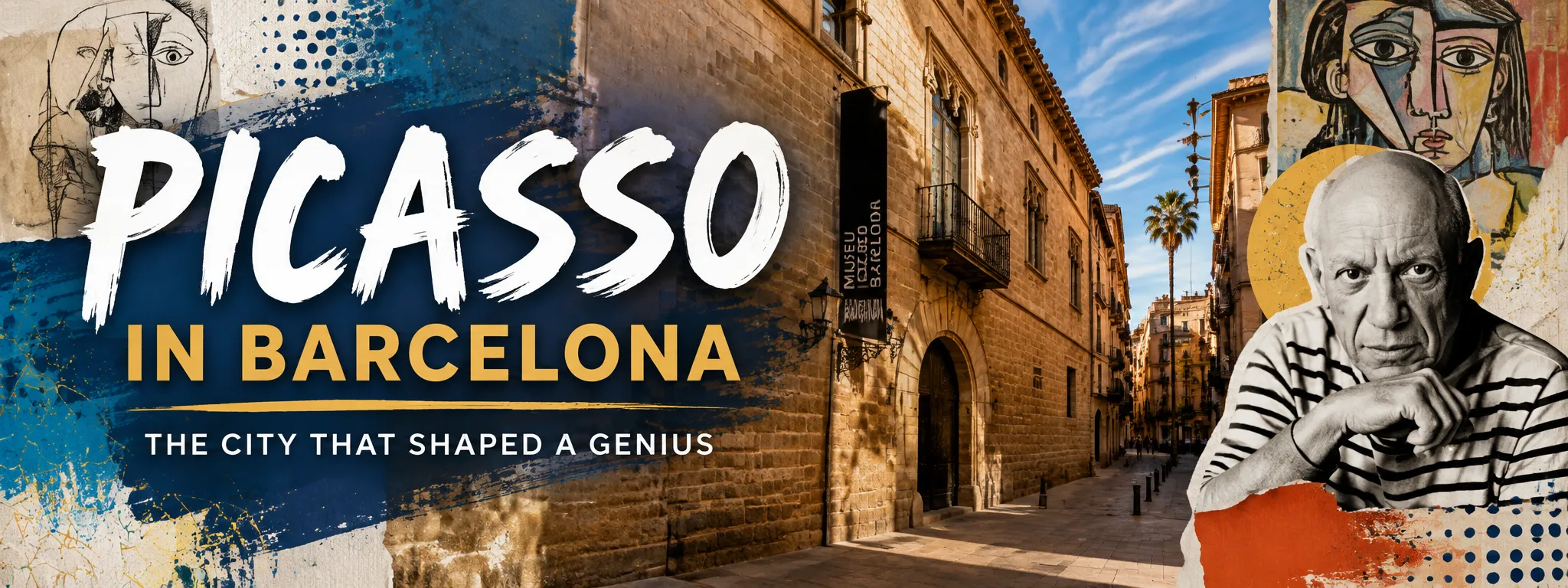
Why Barcelona matters to Picasso
Picasso was born in Málaga, but Barcelona was central to his formation as an artist. He arrived as a teenager, studied here, mixed with the city's avant-garde circles and developed rapidly before Paris became the dominant city in his career. That is why Barcelona's Picasso story is strongest when you approach it as a story of youth, training, friendships and experimentation rather than expecting a museum full of the late celebrity works reproduced on posters.
What the Museu Picasso is especially good at
The Museu Picasso Barcelona describes its collection as particularly strong in his formative years, the Blue Period, works painted in Barcelona in 1917 and the complete Las Meninas series. The collection grew from Jaume Sabartés's holdings, works already in Barcelona museums and major donations by Picasso himself. For visitors, that gives the museum a clear purpose: understanding how the young artist learned, changed and kept a relationship with Barcelona.
Do not go expecting a greatest-hits museum
The museum says its collection contains thousands of works, with a particular emphasis on early Picasso. If your mental checklist is dominated by Guernica and late Cubist icons, reset expectations before entering. The reward here is seeing development: academic studies, portraits, early experiments, Blue Period work and the sustained Las Meninas reinterpretation. That makes the visit more coherent and usually more interesting.
The building is part of the visit
The museum occupies a group of historic palaces on Carrer Montcada in El Born. Its own history records how it expanded from one building into five adjoining properties as the collection grew. Allow some attention for courtyards, stone stairways and the sequence of spaces rather than moving through galleries with your eyes fixed only on labels.
Tickets and opening hours: check the official site
Opening patterns vary by season and the museum closes on Mondays. The official tickets and hours page also lists free-entry periods that require advance reservation and notes that capacity is limited. Because those details can change, use the museum's current calendar rather than relying on an old travel blog. If Picasso is important to your trip, booking a timed slot is the low-stress approach.
How long should you allow?
About 90 minutes is comfortable for many first-time visitors; serious Picasso fans can easily stay longer. If you only have half an hour, the museum offers an audio-guide route built around collection highlights. Avoid placing a hard lunch reservation immediately after your ticket time because queues, temporary exhibitions or simple curiosity can stretch the visit.
Barcelona and the Blue Period
Barcelona is an important setting for the transition into Picasso's Blue Period. The museum's own collection presentation highlights this group of works, so seeing them alongside earlier academic pieces makes stylistic change easier to follow. Read the sequence chronologically where possible instead of jumping only to famous-looking canvases.
Why the Las Meninas series matters
The museum holds Picasso's complete series responding to Velázquez's Las Meninas. The institution records Picasso's 1968 donation of 58 oils that make up the series. Even visitors who are not art-history specialists can use it as a clear example of how an established artist disassembled and reinterpreted a canonical work rather than simply copying it.
Build a small Picasso trail through the city
The museum works well as the anchor for a walk through El Born and the Gothic Quarter, areas tied to Picasso's young Barcelona. Keep the trail modest: museum first, then a few streets and places connected with his early life, followed by another cultural stop or lunch. The city connection is more meaningful when it supports the museum story rather than becoming a scavenger hunt for plaques.
Families and visitors who do not love art museums
The museum's audio-guide programme includes a children's option, and the chronological story gives families a useful way to frame the visit: watch a talented teenager learn and change. For reluctant museum-goers, choose a short highlights route and then explore El Born. One focused hour is better than forcing a two-hour march through every room.
Practical access
The museum is on Carrer Montcada in a busy pedestrian part of El Born. Jaume I on Metro L4 is a common approach, with a walk through the old city. Allow extra time if you are arriving by taxi because vehicles cannot always stop exactly where a pedestrian route suggests. Check the museum's accessibility information if step-free routing is important, as historic buildings can have less obvious accessible entrances and circulation.
The bottom line
Barcelona's Picasso museum is not a substitute for every major Picasso collection in Europe, and it does not need to be. Its value is specificity: youth, formation, Barcelona connections, the Blue Period and Las Meninas, presented inside historic Montcada Street palaces. Go with that story in mind and the collection makes far more sense.