
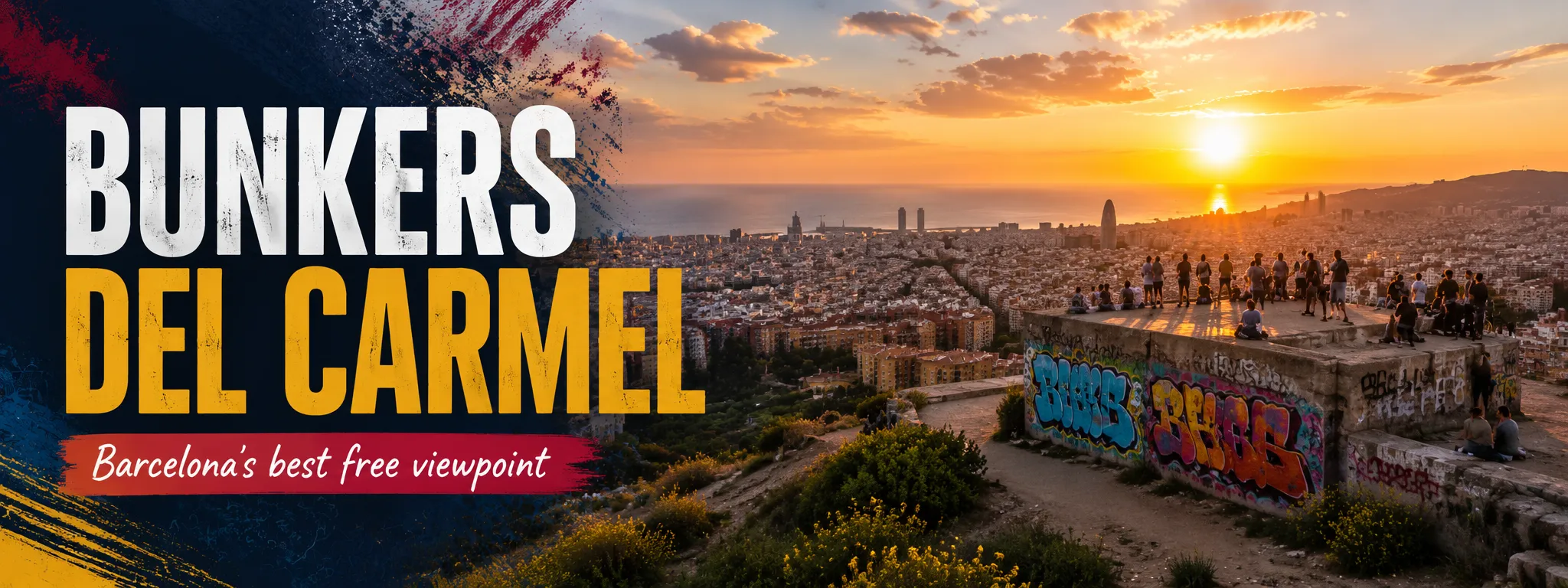
The old sunset advice is out of date
The biggest thing to know about the Bunkers del Carmel in 2026 is that the famous “turn up for sunset and stay as long as you like” advice belongs to an earlier Barcelona. Turó de la Rovira is now gated and night access is restricted after years of crowding, parties and disruption for nearby residents. Closing times can vary by season, so check current MUHBA or Barcelona city information before you climb and do not build your evening around being allowed on the platforms after dark.
What the “bunkers” actually are
The popular name is misleading. Turó de la Rovira contains the remains of a Republican anti-aircraft battery constructed during the Spanish Civil War, not an underground bunker complex. Its 360-degree position made the hill strategically valuable during the bombing of Barcelona. After the war, the site became part of the informal settlement known as Los Cañones, where families built homes on and around the military remains.
That second chapter matters. The hill is not simply a viewpoint with some old concrete. It also tells a story of post-war housing shortage, migration, self-built neighbourhoods and eventual rehousing before the 1992 Olympic transformation of Barcelona. MUHBA interprets both the wartime and shantytown history, so spend a few minutes looking beyond the skyline.
What you can see
The reward for the climb is one of Barcelona's clearest geographic views. The Eixample grid spreads below you; Sagrada Família rises almost in line with the city blocks; the Mediterranean, Montjuïc, Torre Glòries and Collserola help you understand how the city fits between sea and hills. It is a better place for reading Barcelona's shape than for photographing one single monument.
Best time to go now
Morning is the safest recommendation if you want lower crowds, cooler temperatures and fewer worries about the gate. Late afternoon gives warmer light, but confirm the day's closing time first and arrive early enough to enjoy the site without racing the clock. In summer, exposed concrete and limited shade make the middle of the day hard work.
Winter can offer crisp visibility and earlier sunset light, but do not assume historical opening patterns are permanent. The site has changed access rules before, and resident impact remains part of how it is managed.
How to get to Turó de la Rovira
There is no metro station at the summit. The simplest approach is to use a bus that climbs into Horta-Guinardó and walk the final section. Bus routes serving the area can change, so use TMB's current journey planner on the day rather than memorising an old blog route. Metro approaches from Alfons X, El Carmel or nearby stations involve a substantial uphill walk.
A taxi or rideshare can reduce the climb but cannot turn the final approach into a door-to-door attraction. Expect stairs, ramps or steep streets depending on the route you choose.
How hard is the climb?
For a fit adult in mild weather it is manageable; for a stroller, limited mobility, knee problems or a hot August afternoon it can be the main event. The final terrain includes uneven surfaces and exposed edges. Wear proper shoes, bring water and do not rush the descent after the light starts to fade.
If mobility is a concern, Barcelona has easier panoramic options, including Montjuïc viewpoints and accessible tourist transport. A free view is not good value if getting there turns into a physical problem.
Facilities: plan as if there are none
Do not rely on finding toilets, food, drinks or shade exactly when you need them at the top. Bring water, sun protection and anything essential for children. Take rubbish back down with you. The surrounding streets are residential, not an entertainment precinct, so keep noise down and avoid blocking entrances.
MUHBA versus the outdoor viewpoint
The outdoor viewpoint and the museum interpretation do not necessarily operate on the same schedule. MUHBA's exhibition areas have more limited opening periods than the general hilltop access. If the history is important to you, check the museum opening information separately rather than assuming the interpretive spaces will be open whenever the viewpoint is.
Is it good with children?
Older children who cope with hills may enjoy the view and the Civil War history. With toddlers, a bulky stroller or children who run toward edges, it requires more attention than a normal city park. There are exposed drops and uneven surfaces, and the climb can be tiring before you even arrive.
What to combine it with
Turó de la Rovira combines naturally with Horta-Guinardó or Gràcia rather than with a tightly timed old-city schedule. Park Güell is geographically nearby, but putting two hillside attractions back-to-back can be more tiring than the map suggests. If Park Güell is a timed booking, make that the fixed anchor and treat the bunkers as optional rather than risk missing an entry slot.
Is it still worth visiting?
Yes — if you want a free panorama and are prepared for the climb. But visit the 2026 version of the place, not the Instagram version from a decade ago. Go in daylight, respect the gate and neighbours, look at the history as well as the view, and have a Plan B if access hours do not fit your day.
Before you go: check the current MUHBA / Barcelona History Museum information and use TMB for live public-transport routing.