Catalan is normal everyday Barcelona, not a museum label
Barcelona is multilingual, but Catalan is not decorative heritage text: it is a living public language used across schools, government, media, signs, culture and ordinary conversation. I would treat that as part of understanding the city rather than as a test visitors must pass.
The Generalitat's latest Survey of Language Uses of the Population reports that 93.4% of people aged 15+ in Catalonia understand Catalan, 80.4% can speak it, 84.1% can read it and 65.6% can write it. Spanish knowledge is higher across the same measures. That is the reality visitors meet: Catalan is highly visible and widely understood, while Spanish is also close to universal.
The useful language etiquette is simple
If someone begins in Catalan and you do not understand, it is reasonable to ask for Spanish or English. What lands badly is treating Catalan as an inconvenience or assuming it is merely a dialect of Spanish. It is a separate Romance language with its own literature, institutions and standard forms.
A few phrases are enough to show awareness: bon dia (good morning/day), si us plau (please), gràcies (thank you) and adéu (goodbye). I would not turn every café order into a language performance; use what you know naturally and let the conversation find its own level.
Identity is broader than language alone
Catalan identity in Barcelona is expressed through language, neighbourhood associations, festivals, sport, food, design, music, political history and civic institutions. People hold different views about Catalonia's relationship with Spain, and visitors should resist using one conversation, one flag or one demonstration as a shortcut to defining an entire city.
The better approach is to notice context. A Catalan-language theatre programme, a casteller rehearsal, a neighbourhood festa major and an FC Barcelona chant are all pieces of cultural life, but none tells you what every resident believes.
Traditions are lived, not staged for tourists
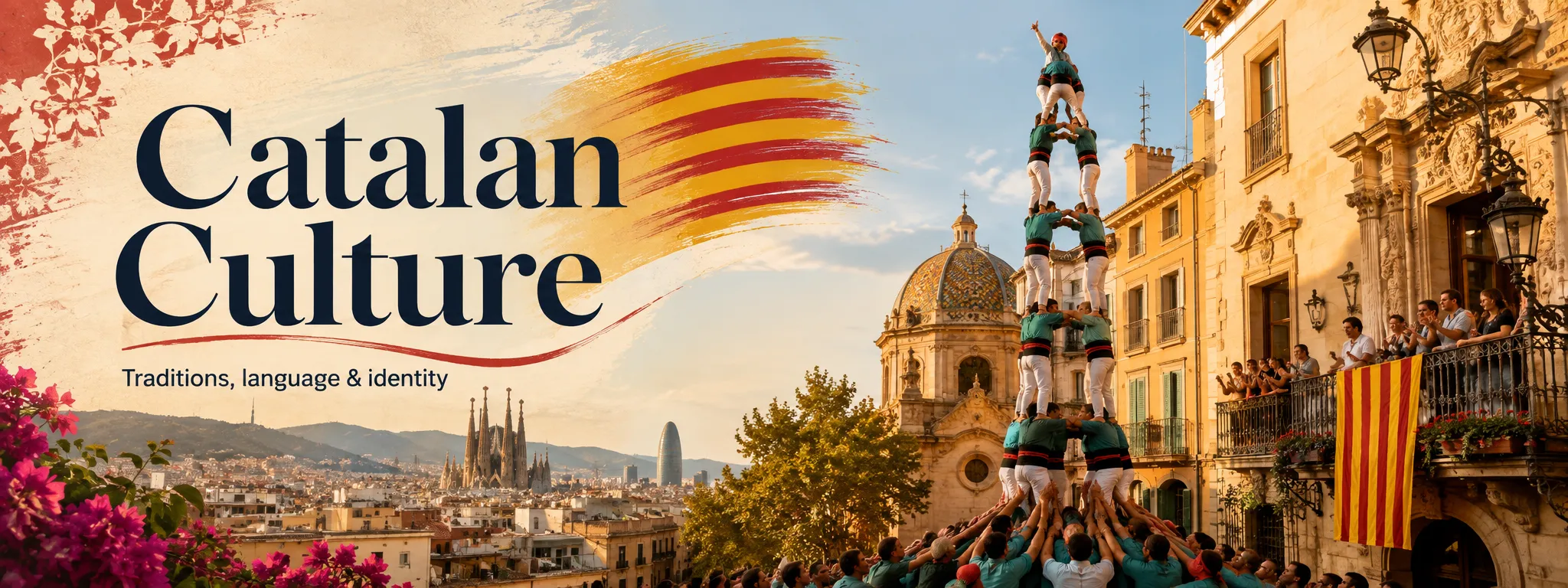
Castellers build human towers through highly organised community groups; gegants and capgrossos appear in festival processions; correfocs bring fire, drums and devils into the street; and the sardana remains a recognisable dance tradition. These can be spectacular, but they are first local community practices rather than theme-park acts.
At a correfoc, follow the event's safety guidance rather than chasing the best photo. At a casteller event, give teams working space. If a neighbourhood celebration blocks your normal route, I would treat the diversion as part of the city functioning on its own terms.
The calendar changes how the city feels
Sant Jordi in April fills streets with books and roses; Sant Joan in June is loud, late and firework-heavy; La Mercè in September brings large civic celebrations; and individual districts run their own festes majors. Dates, programmes and crowd controls change each year, so check the current city programme rather than relying on a copied annual schedule.
Food habits reveal the local rhythm
Catalan food culture is more useful to understand through habits than through a checklist of dishes. Meal times skew later than in many English-speaking countries, markets remain part of daily neighbourhood life, and seasonal ingredients matter. Go deeper through our food guide, neighbourhood markets and Catalan wine and cava pages.
Do not turn a holiday conversation into a referendum
Catalonia's politics are real and sometimes emotionally charged. Independence, autonomy, language policy and Spanish identity are not harmless small-talk prompts for every stranger. If the subject comes up naturally, listen before announcing a verdict based on a weekend in town.
Where to notice Catalan culture
You do not need a special “culture attraction”. Start with local markets, libraries, civic centres, independent bookshops and neighbourhood festivals. For historical context, use the Barcelona history timeline and Civil War guide; for architecture beyond the headline Gaudí sites, see Beyond Gaudí.
A respectful visitor checklist
- Read bilingual signs as normal: do not treat Catalan as an odd extra.
- Use a few phrases if you like: gratitude beats forced fluency.
- Follow festival safety rules: especially around fire and crowded processions.
- Ask, do not assume: identity and politics vary person to person.
- Check current programmes: festival routes and transport impacts change.
Source checked 6 September 2026: Generalitat de Catalunya, Survey of Language Uses of the Population 2023 and subsequent published updates; Barcelona municipal cultural guidance.
Cheers, Carpe Diem & listen to the city in the language it chooses! 🍻⏳🗣️
TATS Man
Your culture-with-context city editor