
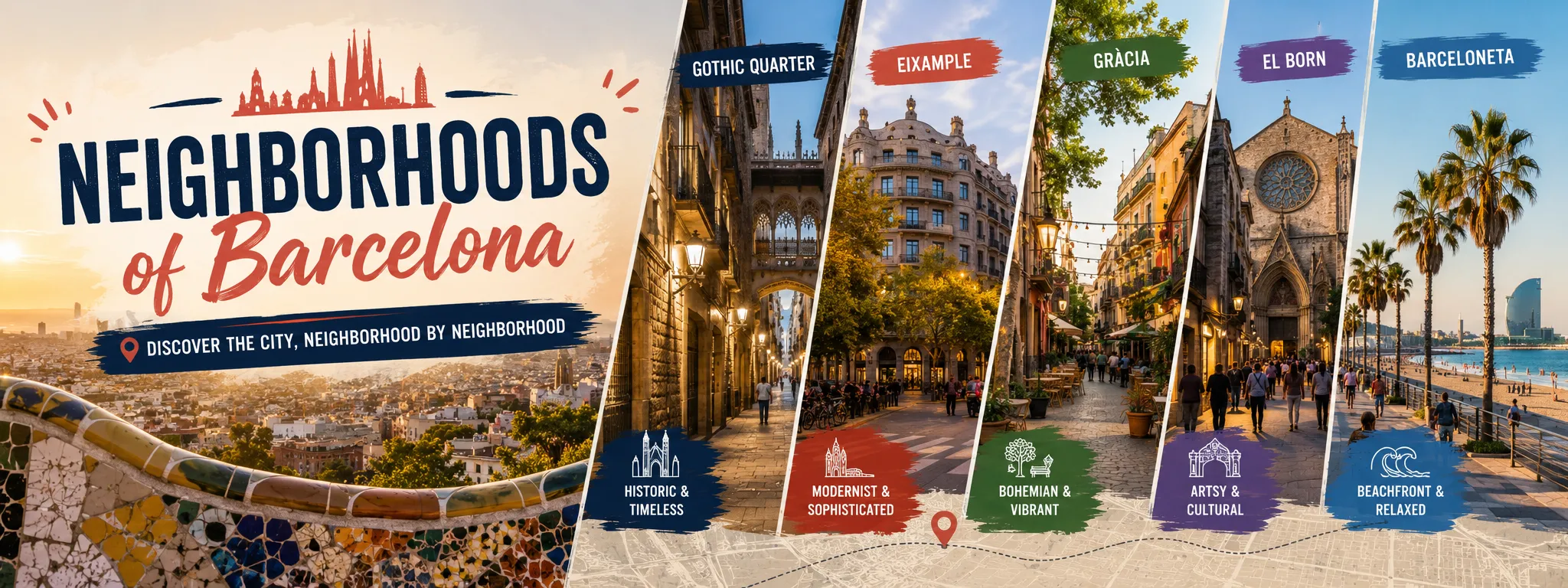
Choose the part of Barcelona that fits the way you actually want to travel: old-city lanes, Modernisme blocks, beach mornings, village squares, nightlife, quiet sleep or easier transport.

I use neighbourhoods as a practical decision, not a ranking. The best base is the one that reduces the journeys you do every day and puts the atmosphere you care about outside the door.
Best when medieval lanes, major sights, bars and walking matter more than quiet streets or easy car access. Born generally feels broader and more evening-oriented; the Gothic Quarter is the denser historic core.
Compare from the Gothic Quarter →My safest first-trip default: a legible grid, strong public transport, broad pavements and easy access to Modernisme landmarks. It trades old-town intimacy for day-to-day convenience.
Read the Eixample guide →Choose Gràcia for lively squares and independent shops; go farther uphill to Sarrià–Sant Gervasi when residential calm matters more than being in the sightseeing core.
Start with Gràcia →Barceloneta puts the old fishing quarter and city beaches together. Poblenou gives you a wider, more modern neighbourhood with creative-industry character and access to the eastern waterfront.
Compare the beach-side options →Barcelona officially has ten administrative districts and many more neighbourhoods. These guides deliberately use the areas travellers are most likely to compare, so they do not map one-to-one onto City Council district boundaries.
Roman Barcino, medieval lanes, the Cathedral and the densest old-city sightseeing.
Read the guide →Santa Maria del Mar, Picasso, market archaeology, boutiques and busy evenings.
Read the guide →Cerdà's grid, Modernisme, Sagrada Família access and one of the easiest bases for transport.
Read the guide →Village-scale streets and squares with a stronger residential feel than the historic centre.
Read the guide →Beach access, maritime history and a very different daily rhythm from the inland centre.
Read the guide →Museums, gardens, viewpoints, the castle and a hillier sightseeing day.
Read the guide →Paral·lel, Refugi 307, neighbourhood food and strong evening access below Montjuïc.
Read the guide →Former industrial fabric, creative businesses, Rambla del Poblenou and eastern beaches.
Read the guide →Leafier streets, village history and a calmer uphill base with longer sightseeing journeys.
Read the guide →MACBA, cultural institutions, dense multicultural streets and sharper block-by-block contrasts.
Read the guide →Residential west Barcelona, the Barça orbit and a quieter alternative to the tourist centre.
Read the guide →Hills, parks, residential streets and routes where gradients and transport planning matter.
Read the guide →Easy orientation, good transport and a useful middle ground between old city and outer districts.
See why → 🌙EveningsOld-city atmosphere with restaurants, bars and cultural sights close together.
Read the guide → 🌊Beach-led tripChoose it because you will actually use the waterfront, not because the map makes it look central.
Read the guide → 🌿Quieter baseBetter for residential calm; less convenient if you expect to return to the centre several times a day.
Read the guide → ⚽Barça-focusedUseful if football is central to the trip, with a quieter residential context around it.
Read the guide → 🛏️Booking a roomNoise, hotel type, access, budget and trip style belong in the accommodation decision too.
Open the Stay comparison →I would save two or three candidate areas, then map the journeys that repeat: airport arrival, the first booked attraction, an evening back from dinner, beach time, and the trip home after a late night. A neighbourhood that looks perfect at noon can feel much less clever when every evening ends with a cross-city transfer.
I also separate where I want to explore from where I need to sleep. You can spend an excellent afternoon in the Gothic Quarter without booking a room over its busiest lanes. Likewise, Montjuïc is worth a dedicated day even if a hillside base would be inconvenient for the rest of your trip.
For the official city geography, Barcelona City Council describes the city as ten districts and 73 neighbourhoods. Our visitor guides group the places people actually compare on a trip, so use the labels as planning tools rather than administrative boundaries.
Cheers, Carpe Diem & choosing the neighbourhood before the room key! 🍻⏳🗺️
TATS Man
your district-by-district decision nerd